The Chinese giant salamander: a living giant on the brink
Farms hold large numbers of Chinese giant salamanders, but wild populations have almost vanished. Genetic research now shows there are several species, which changes how they must be protected.
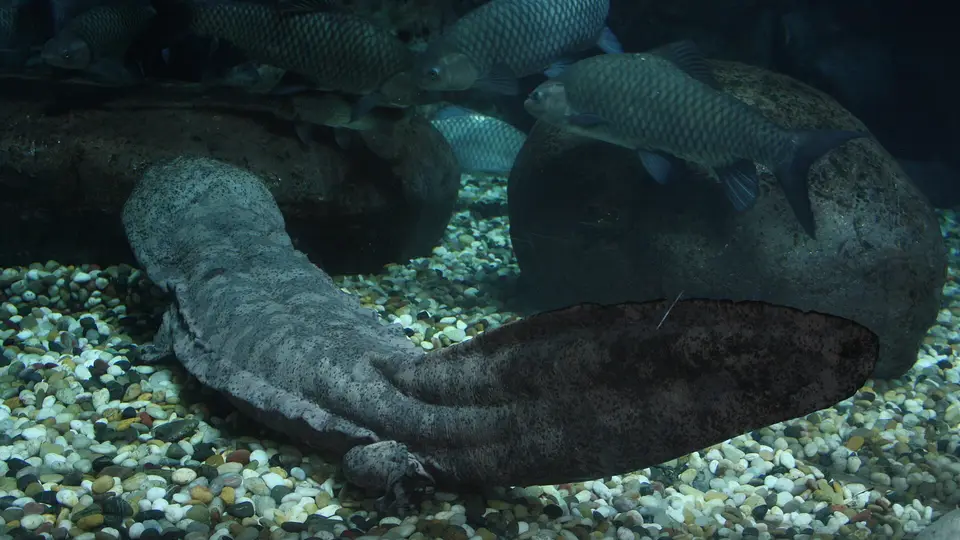
The Chinese giant salamander is among the largest amphibians on Earth. Adults can reach about 1.8 meters in length, far bigger than any frog or newt most people have seen. In Chinese it is called dani (大鲵), and it is often nicknamed wawayu (娃娃鱼), "baby fish," because its calls are said to sound like a crying infant.
Large numbers of these animals live on farms, yet scientists have struggled to find healthy wild populations. Recent genetic research has added a further twist: what was long treated as one species is in fact several. This article explains why that matters.
A giant of mountain streams
Chinese giant salamanders live in cool, clear, rocky streams and rivers in hilly and mountainous parts of central and southern China. They spend their whole lives in water. During the day they usually hide in crevices, under rocks or in underwater dens, and they become active at night.
Their bodies are long, broad and flattened, with a wide head, tiny eyes and loose folds of wrinkled skin along the sides. The skin helps them take in oxygen from the water. They eat fish, crabs, frogs, insects and other small animals, usually by waiting in ambush and sucking prey into their mouths with a sudden gulp.
During the breeding season, eggs are laid in strings inside a den, and the male guards them until they hatch. The animals grow slowly and can live for many years, which means populations take a long time to recover from losses.
Critically Endangered
The Chinese giant salamander is assessed as Critically Endangered on the IUCN Red List, the highest category of extinction risk before extinction in the wild. It is listed in Appendix I of CITES, which prohibits international commercial trade in wild specimens, and it is a nationally protected species in China.
The main causes of decline are:
- Over-harvesting for food. From the late 20th century, salamander meat became a luxury dish, and wild animals were collected to supply restaurants and stock farms.
- Habitat damage, including dams, pollution, mining and changes to river channels.
- Disease, which can spread quickly when animals are crowded together or moved between sites.
Searching for wild salamanders
Between 2013 and 2016, a team of Chinese and international researchers carried out one of the largest surveys of any amphibian. They searched at 97 sites across 16 provinces, choosing places where salamanders had been recorded before or where the habitat looked suitable. Their results, published in Current Biology in 2018, were alarming. Salamanders were found at only four sites, and the team could not confirm the survival of a genuinely wild population at any of the places they surveyed. Some of the animals they did find appeared to have come from farms.
The authors concluded that the species was extremely depleted, or functionally extinct, across the huge area they surveyed.
Farming and release: a well-meant problem
Salamander farming expanded rapidly in China, and farms now hold far more animals than survive in the wild. At first glance this might seem to protect the species. In practice, it has created new risks.
The 2018 survey team reported that many breeding animals on farms had been taken from the wild, or were the first-generation offspring of wild-caught animals. A companion study published in the same issue of Current Biology analyzed salamander DNA and found that wild salamanders belonged to at least five distinct genetic lineages, each linked to different river systems. On farms, however, animals from different regions had been moved and mixed, and lineages from northern China had come to dominate.
Releasing farmed salamanders into rivers has been promoted as a conservation measure. The researchers warned that releases carried out without genetic testing or disease screening could introduce the wrong lineages, or hybrids, into rivers, and spread disease. In other words, well-meant releases could harm the very wild populations they were meant to restore. The same risk applies to many other animals released by the public; see our article on red-eared sliders and invasive pets.
One species, or many?
Genetic research since 2018 has changed scientists' picture of these animals:
- 2019: A study using historical museum specimens, published in Ecology and Evolution, confirmed that the animals belong to more than one species. It recognized the South China giant salamander, Andrias sligoi, from the Pearl River region, which may be the world's largest amphibian, and identified another distinct lineage from the Huangshan Mountains.
- 2022: Researchers described Andrias jiangxiensis from a closed nature reserve in Jiangxi Province. They reported it as the only known giant salamander with a genetically pure, reproducing wild population, and documented hundreds of animals there over 18 months of monitoring.
- 2023: A giant salamander from Qimen County in the Huangshan area of Anhui Province was formally named Andrias cheni, the Qimen giant salamander.
- 2024: A study in the Evolutionary Journal of the Linnean Society, led by researchers from ZSL (Zoological Society of London) and the University of Edinburgh with collaborators, found that the Chinese giant salamanders comprise at least seven, and possibly nine, species-level lineages. Only some of them have formal scientific names.
This matters for conservation. Laws, Red List assessments and breeding programs are organized around species. If several species are managed as one, a species could disappear without anyone noticing, because "the Chinese giant salamander" still appears to survive on farms.
What needs to happen
The researchers behind these studies have made several recommendations:
- Find and protect remaining wild populations, especially those that are genetically pure, and protect their streams.
- Identify which lineage each farmed animal belongs to, so that suitable animals can form part of carefully managed conservation-breeding programs.
- Stop unscreened releases. Any reintroduction should be based on genetic testing and health checks, and should return each species only to its own river system.
- Recognize the separate species in law and policy, so that each receives the protection it needs.
These steps fit within wider efforts to protect China's freshwater biodiversity, which is often less visible than forest or grassland wildlife.
What you can do
- Do not eat giant salamander, and do not buy products made from it. Even where farmed meat is legal, demand keeps pressure on the trade and can hide illegal wild-caught animals. Our guide to the illegal wildlife trade explains how legal and illegal supply chains overlap.
- Never release animals into rivers, however good the intention. Leave reintroduction to authorized conservation programs.
- If you see a salamander in the wild, observe quietly from a distance, do not handle it, and report the sighting to your local forestry or agriculture department or a nature reserve office.
- Report suspected illegal sales of wild-caught salamanders to local authorities.
- Learn and share. Many people are surprised to learn that there is more than one kind of giant salamander. Sharing that knowledge helps build support for protecting them.
References
- Turvey ST, Chen S, Tapley B, et al., "Imminent extinction in the wild of the world's largest amphibian", Current Biology, 2018. https://doi.org/10.1016/j.cub.2018.04.005
- Yan F, Lü J, Zhang B, et al., "The Chinese giant salamander exemplifies the hidden extinction of cryptic species", Current Biology, 2018. https://doi.org/10.1016/j.cub.2018.04.004
- Turvey ST, Marr MM, Barnes I, et al., "Historical museum collections clarify the evolutionary history of cryptic species radiation in the world's largest amphibians", Ecology and Evolution, 2019. https://doi.org/10.1002/ece3.5257
- Chai J, et al., "Discovery of a wild, genetically pure Chinese giant salamander creates new conservation opportunities", Zoological Research, 2022. https://doi.org/10.24272/j.issn.2095-8137.2022.101
- Marr MM, et al., "What's in a name? Using species delimitation to inform conservation practice for Chinese giant salamanders (Andrias spp.)", Evolutionary Journal of the Linnean Society, 2024. https://doi.org/10.1093/evolinnean/kzae007
- Royal (Dick) School of Veterinary Studies, University of Edinburgh, "Critically endangered animal has multiple species", 2024. https://vet.ed.ac.uk/news/latest-news/critically-endangered-animal-has-multiple-species
- Frost DR, Amphibian Species of the World (American Museum of Natural History), "Andrias cheni Xu, Gong, Li, Jiang, Huang, and Huang, 2023". https://amphibiansoftheworld.amnh.org/Amphibia/Caudata/Cryptobranchidae/Andrias/Andrias-cheni