Finless porpoises of the Yangtze and China's coast
The Yangtze finless porpoise is the river's last surviving cetacean. After the baiji's loss, a ten-year fishing ban and new protections have coincided with rising numbers, but the porpoise remains Critically Endangered.
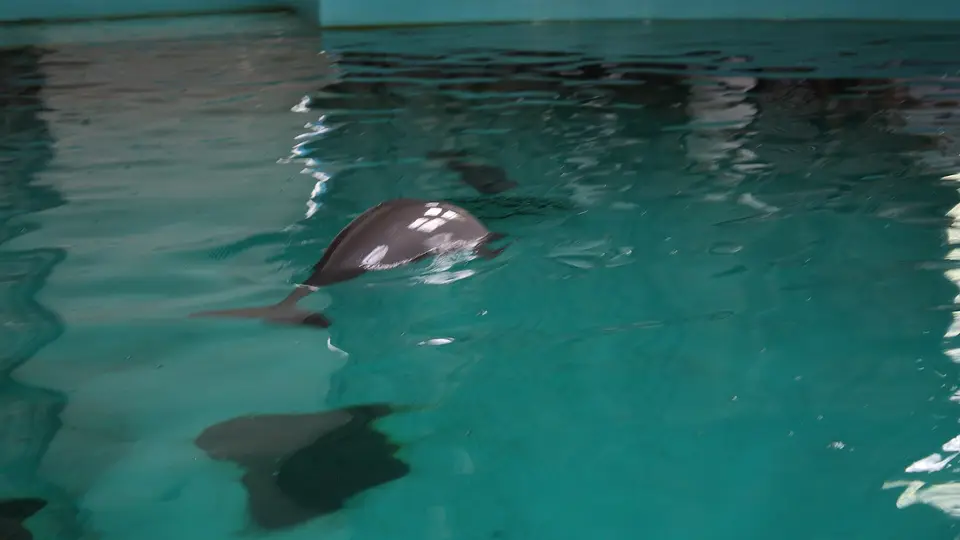
Finless porpoises are small, gray, round-headed toothed whales, related to dolphins. Unlike most dolphins, they have no fin on their back, only a low ridge. In China they are known as jiangtun (江豚), and their upturned mouths have earned them the affectionate nickname "smiling angels."
Two kinds of finless porpoise live in Chinese waters: one in the Yangtze River and its connected lakes, and another along the coast. This article explains how they differ, why the Yangtze porpoise became a symbol of river conservation, and what recent surveys show.
Two porpoises, river and sea
The Yangtze finless porpoise
The Yangtze finless porpoise lives in the middle and lower Yangtze River and in two large connected lakes, Poyang Lake and Dongting Lake. It is the only porpoise known to live entirely in fresh water, and since the loss of the baiji, it is the only cetacean left in the Yangtze.
It has traditionally been treated as a subspecies of the narrow-ridged finless porpoise. A genomic study published in Nature Communications in 2018 found that the Yangtze population is genetically distinct from its marine relatives and shows adaptations to fresh water, and the authors described it as an incipient species. Scientists continue to discuss exactly how it should be classified.
The Yangtze finless porpoise was moved from Endangered to Critically Endangered on the IUCN Red List in 2013. In 2021, when China revised its list of wildlife under state key protection, it was raised from second-class to first-class protection.
The East Asian finless porpoise
The East Asian finless porpoise lives in shallow coastal waters of the Yellow Sea and East China Sea, including the waters off Zhejiang, as well as around Korea and Japan. It favors water close to shore, soft or sandy seabeds and estuaries, where rivers meet the sea. Because it lives so close to busy coasts, it is exposed to fishing nets, ship traffic, coastal development and pollution, and it is considered threatened.
The lesson of the baiji
The baiji, or Yangtze River dolphin, once shared the river with the finless porpoise. It was a pale, long-beaked dolphin found only in the Yangtze.
In late 2006, an international expedition spent six weeks searching the main channel of the Yangtze for baiji and found none. A paper describing the survey, published in Biology Letters in 2007, concluded that the baiji was now likely to be extinct, probably because of unsustainable accidental catch in local fisheries. The baiji is widely described as functionally extinct.
The baiji's disappearance showed how quickly a river species can be lost when threats are not addressed in time. It also turned attention to the finless porpoise, which faced many of the same pressures.
Why the Yangtze porpoise declined
The Yangtze is one of the busiest rivers in the world. Over recent decades its porpoises faced:
- Fishing gear and illegal fishing methods, including electrofishing, which can kill porpoises directly and deplete the fish they eat.
- Shipping traffic, which brings the risk of collisions and underwater noise that can interfere with the porpoise's use of sound to navigate and find prey.
- Sand mining and channel works, which disturb and change habitat.
- Dams and pollution, which alter river flows and water quality.
Surveys found that the population roughly halved between 2006 and 2012. A further survey in 2017 counted 1,012 porpoises.
The Yangtze fishing ban and new protections
China has taken major steps to protect the river. Fishing restrictions began in protected areas in 2020, and from 1 January 2021 a ten-year ban on commercial fishing took effect in key waters of the Yangtze basin, including the main stream and major tributaries and lakes. The Yangtze River Protection Law also took effect in 2021. Fishers were moved into other work, and enforcement against illegal fishing was stepped up.
The aim is to give fish stocks, and the animals that depend on them, time to recover. Because the finless porpoise is a top predator in the river, its condition is seen as an indicator of the health of the Yangtze as a whole.
What recent surveys show
Survey numbers should be read carefully. They come from boat-based counts with some uncertainty, and different surveys may cover slightly different areas. Even so, the trend reported by the Ministry of Agriculture and Rural Affairs has been encouraging:
- 2017: 1,012 porpoises.
- 2022: 1,249 porpoises, the first full survey after the fishing ban began. The count was 595 in the Yangtze main stream, 492 in Poyang Lake and 162 in Dongting Lake.
- 2025: 1,426 porpoises, an increase of 177 compared with 2022. The figure was announced at a State Council Information Office press conference on 30 January 2026, during a mid-term review of the ten-year fishing ban.
Officials have stressed that the recovery of the Yangtze's aquatic life will be a long and slow process. With fewer than 1,500 individuals, the Yangtze finless porpoise remains Critically Endangered.
Porpoises in coastal rivers and estuaries
Finless porpoises along the coast often use river mouths and estuaries, where fresh water meets the sea and fish are plentiful. These are also places where people fish, build ports and dredge channels, so encounters are common. Sometimes porpoises are found stranded, entangled in nets, or dead on mudflats and riverbanks.
If you find a stranded, injured or dead porpoise:
- Keep people and dogs back, and do not try to push a live animal back into the water yourself.
- Contact the local fisheries authority (part of the agriculture and rural affairs department), the marine police or a recognized rescue organization as quickly as possible.
- Note the location, time and condition of the animal, and take photos from a safe distance if possible. This information can help scientists understand threats.
Our guide on finding an injured wild animal gives general advice.
How you can help
- Never buy or eat fish caught illegally, and report illegal fishing in protected waters to the authorities.
- Watch from a distance. If you see porpoises from a boat or riverbank, keep noise down and do not chase them.
- Reduce plastic and chemical pollution, which ends up in rivers and the sea.
- Get involved in river monitoring. Schools can take part in projects such as student river watch to learn about local waterways, with adult supervision and attention to water safety.
- Learn about freshwater habitats. Our article on wetland ecosystems explains how rivers, lakes and floodplains support wildlife.
The finless porpoise is a reminder that the Yangtze, home to hundreds of millions of people, is also a living river. Its future depends on keeping it that way.
References
- Turvey ST, Pitman RL, Taylor BL, Barlow J, et al., "First human-caused extinction of a cetacean species?", Biology Letters, 2007. https://doi.org/10.1098/rsbl.2007.0292
- Zhou X, Guang X, Sun D, Xu S, et al., "Population genomics of finless porpoises reveal an incipient cetacean species adapted to freshwater", Nature Communications, 2018. https://doi.org/10.1038/s41467-018-03722-x
- Mongabay, "Yangtze finless porpoise drops to Critically Endangered", 2013. https://news.mongabay.com/2013/07/yangtze-finless-porpoise-drops-to-critically-endangered/
- Sixth Tone, "After 30 Years, China Revises Its Protected Wild Animals List", 2021. https://www.sixthtone.com/news/1006814
- Chinese Academy of Sciences (CAS in Media, from Global Times), "Growing Number of Finless Porpoises Observed in Jiangsu, Indicates Eco Improvement of Yangtze River", 2022. https://english.cas.cn/newsroom/news--archives/2022/cas-in-media/202209/t20220928_1125924.shtml
- Global Times, "Number of 'smiling angel' dolphins in Yangtze River rebounds after fishing ban: scientific survey", 2023. https://www.globaltimes.cn/page/202303/1286403.shtml
- Xinhua, "1426头!长江江豚数量实现恢复性增长" (Yangtze finless porpoise numbers recover to 1,426), 2026. https://www.news.cn/politics/20260130/597b750309264e9186ac584acd6de664/c.html
- CGTN, "Ten-year fishing ban drives aquatic recovery in Yangtze River", 2026. https://news.cgtn.com/news/2026-01-30/Ten-year-fishing-ban-drives-aquatic-recovery-in-Yangtze-River-1Km6POpPZ7y/p.html