Pangolins: why the world's scaly anteaters need protection
Pangolins are shy, scale-covered mammals that eat ants and termites. All eight species are threatened, and international and Chinese law now give them the highest protection.
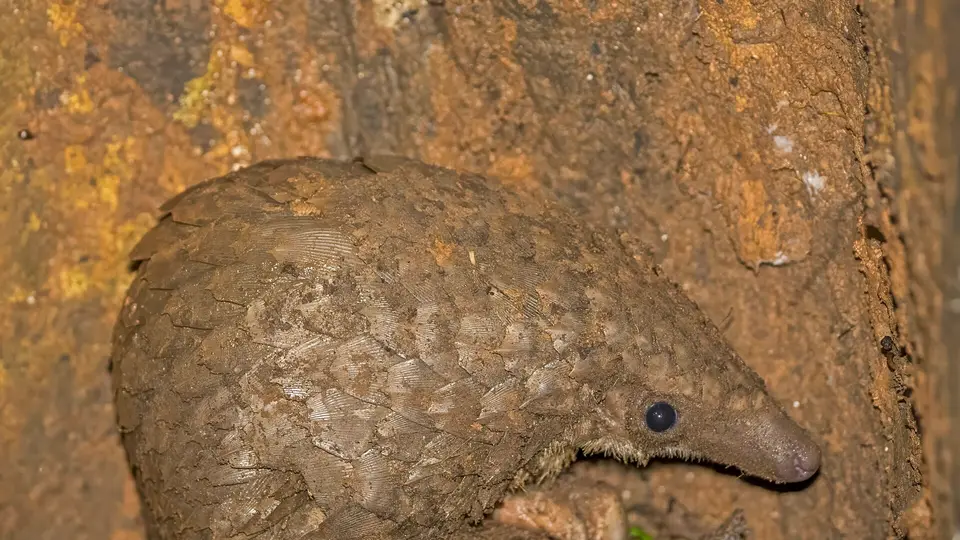
Pangolins look like something between an anteater and a pine cone. They are mammals, they feed their young on milk, and they are covered from head to tail in hard, overlapping scales. They are also among the animals most affected by the illegal wildlife trade. This article introduces pangolin biology, the eight species, and the laws that now protect them.
A mammal in armor
Pangolin scales are made of keratin, the same protein that forms human fingernails and hair. When threatened, a pangolin curls into a tight ball, protecting its soft belly and face behind the scales. This defense works well against many natural predators, but it does not help against people, who can simply pick the animal up.
Pangolins have no teeth. They feed almost entirely on ants and termites, using strong front claws to break into nests and mounds, and a long, sticky tongue to collect the insects. They are mostly nocturnal, secretive and hard to study in the wild, which is one reason scientists still know relatively little about how many remain.
Some species live mainly on the ground and dig burrows. Others, including the African tree pangolin shown in the photo above, spend much of their time in trees and use their tails to grip branches. Females usually give birth to a single young, which may ride on its mother's back or tail as she moves around. Slow breeding means that populations recover slowly once they have been reduced.
The eight species
There are eight living pangolin species: four in Asia and four in Africa. The IUCN Species Survival Commission Pangolin Specialist Group lists them, with their current IUCN Red List categories, as follows.
Asian species
- Chinese pangolin (Manis pentadactyla): Critically Endangered
- Sunda pangolin (Manis javanica): Critically Endangered
- Philippine pangolin (Manis culionensis): Critically Endangered
- Indian pangolin (Manis crassicaudata): Endangered
African species
- White-bellied pangolin, also called the African tree pangolin (Phataginus tricuspis): Endangered
- Giant pangolin (Smutsia gigantea): Endangered
- Black-bellied pangolin (Phataginus tetradactyla): Vulnerable
- Temminck's pangolin (Smutsia temminckii): Vulnerable
The Chinese pangolin is the species most closely associated with China.
In a 2019 Red List update, the Philippine pangolin was moved up to Critically Endangered, while the white-bellied and giant pangolins were moved up from Vulnerable to Endangered. All eight species are now classed as threatened with extinction.
Why pangolins are trafficked
Pangolins are hunted and traded for two main products: their meat, which is eaten in some places as wild food or a luxury dish, and their scales, which have been used in traditional medicine. Scales are light, easy to hide and can be traded in large volumes, which makes them attractive to smugglers.
As Asian pangolin populations declined, traffickers increasingly turned to African species to meet demand.
Because pangolins are slow to breed and difficult to keep in captivity, there is no reliable way to "farm" them to meet demand. Protection in the wild, combined with reduced demand, is the only realistic path to recovery.
CITES Appendix I: an international ban on commercial trade
All eight pangolin species were previously listed in Appendix II of CITES, which allowed regulated international trade with permits. This proved hard to enforce, partly because the species look similar and their scales are hard to tell apart.
At the 17th meeting of the Conference of the Parties to CITES (CoP17), held in Johannesburg, South Africa, in 2016, the Parties agreed to transfer all eight pangolin species to Appendix I. This means that international commercial trade in wild pangolins and their parts is prohibited. The Parties also adopted a resolution on the conservation of and trade in pangolins, which encourages countries to strengthen enforcement, reduce demand and manage stockpiles of seized scales.
China's 2020 protection upgrade
China has also raised pangolin protection at home. On 5 June 2020, the National Forestry and Grassland Administration announced that all pangolin species would be upgraded to first-class national protection, the highest level of protection under Chinese wildlife law.
Around the same time, the 2020 edition of the Chinese Pharmacopoeia, the official list of approved medicinal ingredients, was reported to no longer include pangolin scales in its main list. Conservation groups welcomed both changes as important signals that pangolin products should not be used.
Pangolins are now covered by China's revised Wildlife Protection Law, which took effect in 2023. Hunting, buying, selling, transporting or eating them is illegal. The links between wildlife markets and disease risk, which became a major public concern in 2020, are explored in our article on wildlife markets and public health.
Challenges that remain
Laws are only as strong as their enforcement. Pangolins still face several problems:
- Ongoing smuggling. Seizures show that trafficking networks continue to operate, especially between Africa and Asia.
- Habitat loss. Forest clearance reduces the places where pangolins can live and find food.
- Lack of data. Because pangolins are nocturnal and shy, it is hard to count them or measure whether protection is working.
- Rescue and rehabilitation. Rescued pangolins are often stressed, injured or dehydrated, and they need specialist care before any release.
How you can help
- Never buy pangolin products, including meat, scales, or medicines that list pangolin as an ingredient. If you are unsure what a product contains, ask, and choose alternatives.
- Report suspected trade to local forestry or market-regulation authorities, or to the police. Use the reporting tools on online platforms if you see pangolin products advertised.
- Do not handle or try to keep a wild pangolin. If you find one, keep your distance and contact your local wildlife authority or a licensed rescue centre. Our guide on finding an injured wild animal explains what to do.
- Share accurate information. Many people have never seen a pangolin. Teaching others about these animals is one of the simplest ways to protect them.
References
- IUCN SSC Pangolin Specialist Group, "The 8 Species". https://pangolinsg.org/pangolins
- CITES Secretariat, Standing Committee document SC69 Doc. 57 on pangolins (reports the CoP17 transfer of all eight species to Appendix I), 2017. https://cites.org/sites/default/files/eng/com/sc/69/E-SC69-57.pdf
- Mongabay, "Commercial trade in all eight pangolin species has just been banned", 2016. https://news.mongabay.com/2016/09/commercial-trade-in-all-eight-pangolin-species-has-just-been-banned/
- Mongabay, "Three pangolin species closer to extinction: IUCN", 2019. https://news.mongabay.com/2019/12/three-pangolin-species-closer-to-extinction-iucn/
- China Development Brief, "Pangolin scales removed from official list of medical products", 2020. https://chinadevelopmentbrief.org/reports/pangolins-scales-removed-from-official-list-of-medical-products/