Environmental education for children: what it is and how to start
Environmental education helps children notice, understand and care for the world around them. Here is where the idea comes from, how it changes with age, and practical first steps for families and schools.
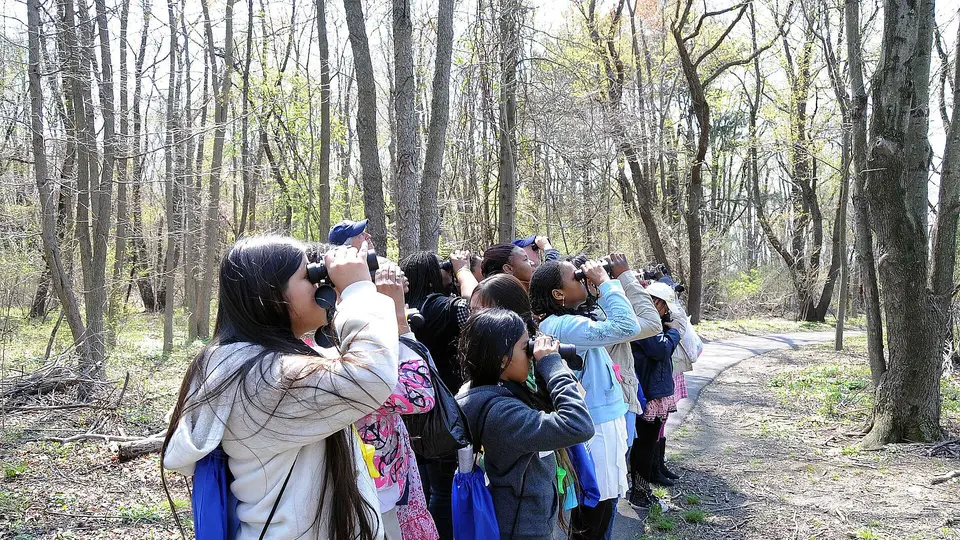
Environmental education is more than teaching children facts about pollution or endangered animals. At its best it helps young people notice the living world around them, understand how it works, care about what happens to it, and gain the skills and confidence to act. This guide explains where the idea comes from, how it can be adapted for different ages, what research does and does not tell us, and how parents and teachers can make a practical start.
Where the idea comes from: the Tbilisi Declaration
Environmental education as an international field took shape in the 1970s. A landmark moment was the Intergovernmental Conference on Environmental Education, organized by UNESCO in cooperation with the United Nations Environment Programme (UNEP) and held in Tbilisi, Georgia (then part of the USSR), from 14 to 26 October 1977. The declaration and recommendations adopted there are still widely used as a framework.
The Tbilisi Declaration set out three broad goals for environmental education:
- To foster clear awareness of, and concern about, the economic, social, political and ecological interdependence of urban and rural areas.
- To give every person opportunities to acquire the knowledge, values, attitudes, commitment and skills needed to protect and improve the environment.
- To create new patterns of behavior towards the environment among individuals, groups and society as a whole.
It also described five categories of objectives, which remain a useful checklist for anyone planning a lesson or a family project:
- Awareness – becoming sensitive to the environment and its problems.
- Knowledge – gaining a range of experiences and a basic understanding of the environment.
- Attitudes – developing values and a feeling of concern, and the motivation to take part in protecting it.
- Skills – learning how to identify and help solve environmental problems.
- Participation – having the chance to be actively involved, at every level, in working towards solutions.
Today, UNESCO places environmental education within the wider idea of education for sustainable development (ESD), which also covers social and economic questions such as fair use of resources. For families and schools, the practical message is the same: knowledge matters, but so do feelings, skills and real opportunities to take part.
Age-by-age approaches
Children learn differently at different stages. The suggestions below are general guidance, not fixed rules; every child and every group is different.
Early years (roughly ages 2–5)
Young children learn through their senses and through play. The aim at this age is comfort, curiosity and enjoyment outdoors, not information about global problems.
- Spend unhurried time outside: puddles, leaves, stones, insects, birdsong.
- Name what you see together, and let children lead the pace.
- Grow something quick and visible, such as beans or sunflowers.
- Model gentle behavior: look at small animals without picking them up, and put back any stone you turn over.
Many educators caution against loading very young children with frightening messages about environmental disasters. A sense of wonder and safety comes first; concern and action can build on it later.
Primary school (roughly ages 6–10)
Children at this age enjoy collecting, sorting, counting and caring for things.
- Keep a simple nature journal or a seasonal "sightings" list.
- Adopt a patch of schoolyard or a balcony planter and record changes over a year.
- Count birds at a feeder or in a park, and learn a few common species well.
- Begin small household habits, such as sorting waste or turning off lights, and explain why they matter.
Lower secondary (roughly ages 11–14)
Older children can investigate questions, collect data and start to see how systems connect.
- Run a schoolyard biodiversity survey or a waste audit (see our guide to school conservation activities).
- Join a citizen-science project through a teacher's or parent's account, since many platforms have minimum age rules.
- Explore cause and effect: where does our water come from, and where does it go?
Teenagers (roughly ages 15–18)
Teenagers can handle complexity, competing interests and genuine responsibility.
- Lead projects, present findings to the school or community, and evaluate what worked.
- Discuss real trade-offs, for example between development and habitat protection.
- Learn about careers and volunteering in conservation, science, policy and communication.
What the research suggests
There is a growing body of research on environmental education and on time spent in nature, but it should be read carefully. Most studies are small, many rely on self-reported outcomes, and programs differ widely.
- A 2018 review by Nicole Ardoin and colleagues analyzed 119 peer-reviewed studies of environmental education for school-age students (published between 1994 and 2013). Most reported positive outcomes, spanning environmental knowledge and attitudes as well as academic, civic and social-emotional measures. The authors also identified gaps, particularly in measuring actual behavior and long-term effects.
- A 2020 systematic review by Ardoin and Bowers looked at 66 studies of environmental education in early childhood (from birth to about age eight). It found mostly positive findings for environmental literacy and for cognitive, social and emotional development, while noting the limits of the evidence base.
- A 2015 review by Louise Chawla summarized research on the benefits of contact with nature for children, including physical health, attention and self-control, psychological well-being and a sense of connection with other living things, and argued that children need access to green space near where they live, play and learn.
- A 2019 review by Ming Kuo and colleagues concluded that experiences in nature appear to support children's learning and personal development, and proposed several possible pathways, such as reduced stress, improved attention and greater interest and enjoyment.
The honest summary is that the evidence points in an encouraging direction, but it does not prove that any one program will produce a particular result. Good practice is still important: clear aims, active involvement, time outdoors, and follow-up.
Practical starting points
You do not need special equipment or a nature reserve to begin. Here are some low-cost first steps.
For parents
- Make outdoor time routine, even if it is 20 minutes in a local park.
- Borrow or buy a simple field guide or use a beginner-friendly identification app together.
- Turn everyday tasks into learning: compost food scraps, check the water meter, or repair a broken toy instead of replacing it. Our family sustainability projects guide has more ideas.
For teachers
- Start with the schoolyard. Short, regular outdoor lessons are often more valuable than one big trip.
- Link activities to existing subjects: measurement in math, observation in science, descriptive writing in language lessons.
- Read our introduction to nature-based learning for approaches and evidence.
For both
- Follow the principles of ethical wildlife observation: keep a respectful distance, do not feed or chase animals, and leave nests and burrows undisturbed.
- Never let children handle wild animals. If you find an animal that seems injured, do not try to treat it yourself; see our guide on what to do if you find an injured wild animal and contact local wildlife authorities or a licensed rescue center.
Safety basics
Environmental education should be safe as well as engaging. Adults should supervise all outdoor activities, especially near roads, steep ground or water. Check the weather, bring water and sun protection, and know about any allergies or medical needs in the group. Keep children well away from deep or fast-flowing water, and never allow wading without proper planning and supervision. Teach children to wash their hands after outdoor activities and before eating.
Further reading
For reliable organizations and data sources, see our curated list of trusted sources.
References
- UNESCO, "Intergovernmental Conference on Environmental Education, Tbilisi (USSR), 14–26 October 1977: Final Report", 1978 (copy hosted by the Global Development Research Center). https://gdrc.org/uem/ee/EE-Tbilisi_1977.pdf
- UNESCO, "Education for sustainable development: what you need to know". https://www.unesco.org/en/sustainable-development/education/need-know
- Ardoin, N. M., Bowers, A. W., Roth, N. W. and Holthuis, N., "Environmental education and K-12 student outcomes: A review and analysis of research", The Journal of Environmental Education 49(1), 2018. https://doi.org/10.1080/00958964.2017.1366155
- Ardoin, N. M. and Bowers, A. W., "Early childhood environmental education: A systematic review of the research literature", Educational Research Review 31, 2020. https://doi.org/10.1016/j.edurev.2020.100353
- Chawla, L., "Benefits of nature contact for children", Journal of Planning Literature 30(4), 2015. https://doi.org/10.1177/0885412215595441
- Kuo, M., Barnes, M. and Jordan, C., "Do experiences with nature promote learning? Converging evidence of a cause-and-effect relationship", Frontiers in Psychology 10:305, 2019. https://doi.org/10.3389/fpsyg.2019.00305
- North American Association for Environmental Education, "The Benefits of EE and Nature Connections in Early Childhood". https://naaee.org/programs/eeworks/benefits-early-childhood