School conservation activities: practical project ideas for teachers and students
Six hands-on conservation projects that schools can run with modest resources, from bird counts and biodiversity surveys to waste and energy audits, plus advice on planning, safety and sharing results.
Schools are well placed to do real conservation work. They have a site to study, a steady supply of curious people and a timetable that allows projects to be repeated year after year. The activities below need little special equipment, can be adapted for different ages, and produce results that students can see and share. Each one links naturally to science, mathematics, geography and language lessons.
1. Schoolyard biodiversity survey
A biodiversity survey (sometimes run as a one-day "bioblitz") asks a simple question: what lives here?
How it works
- Divide the school grounds into zones: lawn, flower beds, trees, walls, paved areas, any pond or ditch.
- Give each team a zone, a time limit and a recording sheet. Teams note plants, insects, spiders, birds, snails and signs of animals such as droppings, nests or chewed leaves.
- Use simple identification guides. Where an exact species name is too hard, recording a group ("beetle", "grass", "moth") is fine.
- Repeat the survey in another season or the following year and compare.
Using apps
Photo-based identification apps can help, but check age rules first. iNaturalist's terms limit accounts to people aged 13 and over unless a parent has given permission. Its companion app, Seek, is designed for younger users and can be used without an account. Many teachers use a single class account managed by an adult.
Learning outcomes: species identification, sampling methods, habitat comparison, data presentation.
2. Bird counts
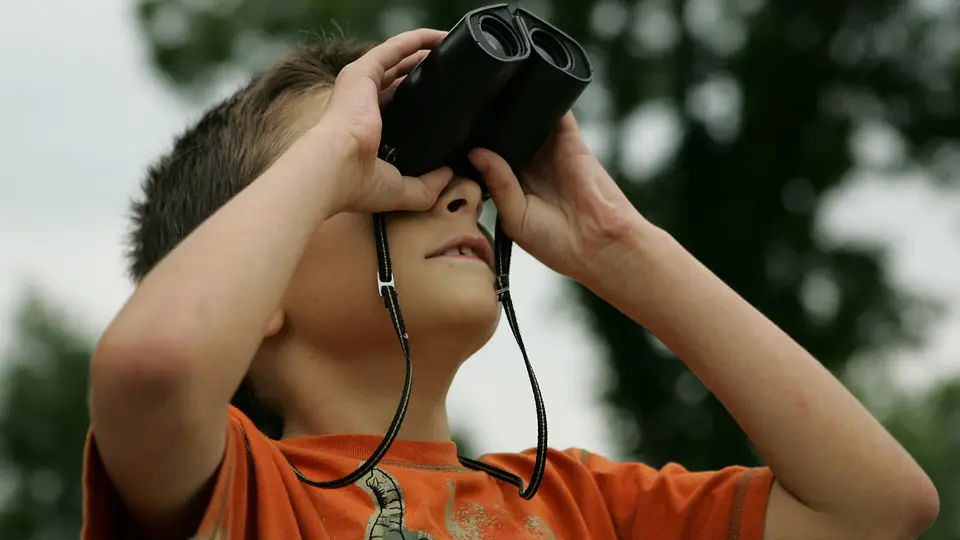
Birds are visible, active all year and well documented, which makes them ideal for regular monitoring.
- Weekly count: pick a fixed spot and a fixed time—say 10 minutes every Monday morning—and record every bird seen or heard. Over months, students can graph changes and spot seasonal migrants.
- eBird: run by the Cornell Lab of Ornithology, eBird collects bird checklists from observers around the world and makes the data available for research and conservation. A teacher or parent can submit a class's counts.
- Great Backyard Bird Count: a four-day event held each February by the Cornell Lab, the National Audubon Society and Birds Canada. Participants can count for as little as 15 minutes and submit their lists.
- China: birdwatchers in mainland China also share records through Chinese-language platforms such as the China Bird Report Center (birdreport.cn).
Many schools in East Asia lie along a major migration route. Our article on the East Asian–Australasian Flyway explains why spring and autumn counts can be especially interesting.
Remind students to observe from a distance and never approach nests. See ethical wildlife observation for good practice.
3. Waste audit
A waste audit measures what a school throws away, so that students can propose and test ways to reduce it.
Planning
- Agree the scope: one day's waste from classrooms, the canteen, or the whole school.
- Get permission from school leaders and cleaning staff, who are key partners.
Running it safely
- Adults should pre-check bags and remove anything hazardous (sharp objects, broken glass, medical or sanitary waste, chemicals).
- Students wear gloves and, where needed, aprons; work outdoors or in a well-ventilated area; and wash hands thoroughly afterwards.
- Sort into categories such as food waste, paper, plastics, metal, glass and "other". Weigh or count each category.
Follow-up
Students analyze the results, identify the biggest categories and suggest changes—perhaps reusable cups, better-labeled bins, or smaller portions in the canteen. A repeat audit a few months later shows whether the changes worked.
4. Energy audit
An energy audit helps students understand where energy is used and wasted in the school building.
- Walk the building with a checklist: lights left on in empty rooms, equipment on standby, windows open while heating or air conditioning runs, unshaded sun-facing windows.
- If the school shares its utility bills or meter readings, students can graph monthly use and look for patterns.
- Simple tools such as a thermometer, and plug-in power meters where available, add data.
- Students then propose low-cost measures—switch-off reminders, a "last out, lights out" rota, adjusted thermostat settings—and measure the effect.
Always involve facilities staff, and never let students open electrical panels or handle wiring.
5. Native planting
Planting native species can provide food and shelter for local insects and birds, and gives students a long-term project to care for.
- Ask a local botanic garden, nature reserve, university or experienced gardener which plants are native to your area and suited to your site.
- Start small: a strip of flowering plants for pollinators, a hedge, or a few shrubs that provide berries.
- Avoid invasive non-native plants, and never release pets or aquarium plants and animals into the wild. Our article on red-eared sliders and invasive pets explains why.
- Avoid pesticides; they can harm the insects you are trying to support.
- Monitor the planting with your biodiversity survey to see which species move in.
6. Citizen-science projects
Citizen science lets students contribute observations to real scientific datasets. Some well-established options:
- iNaturalist – records of any wild species, identified with help from a global community. Schools often take part in the City Nature Challenge, an annual spring event in which cities around the world compete to record as many observations as possible.
- eBird – bird checklists.
- The GLOBE Program – an international science and education program in which students collect environmental data, such as weather, soil and water measurements, using standard protocols.
- Water monitoring – students test a local stream or pond and record wildlife living in it. See our student river watch guide for a complete method.
Planning tips that apply to every project
Link to the curriculum. Projects last longer when they serve existing learning goals—statistics, report writing, ecology—rather than being an add-on.
Plan for repetition. One survey is a snapshot. Repeating it each term or year builds a dataset that students can be proud of and that shows real change.
Get permissions early. Talk to school leaders, facilities staff and, for off-site work, landowners or park managers.
Protect student privacy. Do not publish students' full names, faces or home locations online without consent. On citizen-science platforms, use a supervised class account where possible and follow each platform's age rules.
Keep it safe. Follow your school's supervision and risk-assessment procedures. Keep students away from water, roads and hazardous waste unless properly planned. Wild animals should never be handled.
Share the results. Present findings at an assembly, in a school newsletter, to the parents' association, or to local authorities. Seeing that their work is used is highly motivating for young people—our guide to youth environmental participation explores this further.
Celebrate effort as well as results. A survey that finds few species is still valuable data, and a waste audit that shows little change is still a lesson in how hard behavior change can be.
References
- iNaturalist Help, "How can I make an account for my child who is under 13 years of age?". https://help.inaturalist.org/en/support/solutions/articles/151000216150-how-can-i-make-an-account-for-my-child-who-is-under-13-years-of-age-
- iNaturalist Help, "What is the difference between iNaturalist and Seek by iNaturalist?". https://help.inaturalist.org/en/support/solutions/articles/151000169914-what-is-the-difference-between-inaturalist-and-seek-by-inaturalist-
- Cornell Lab of Ornithology, "About eBird". https://ebird.org/about
- National Audubon Society, "About the Great Backyard Bird Count". https://www.audubon.org/conservation/about-great-backyard-bird-count
- The GLOBE Program, "About GLOBE". https://www.globe.gov/about
- City Nature Challenge. https://www.citynaturechallenge.org/