Migratory birds of the East Asian–Australasian Flyway
Every year, millions of waterbirds travel between the Arctic and Australasia, relying on China's coast to rest and feed. Meet some of the flyway's rarest travelers and learn how to help them.
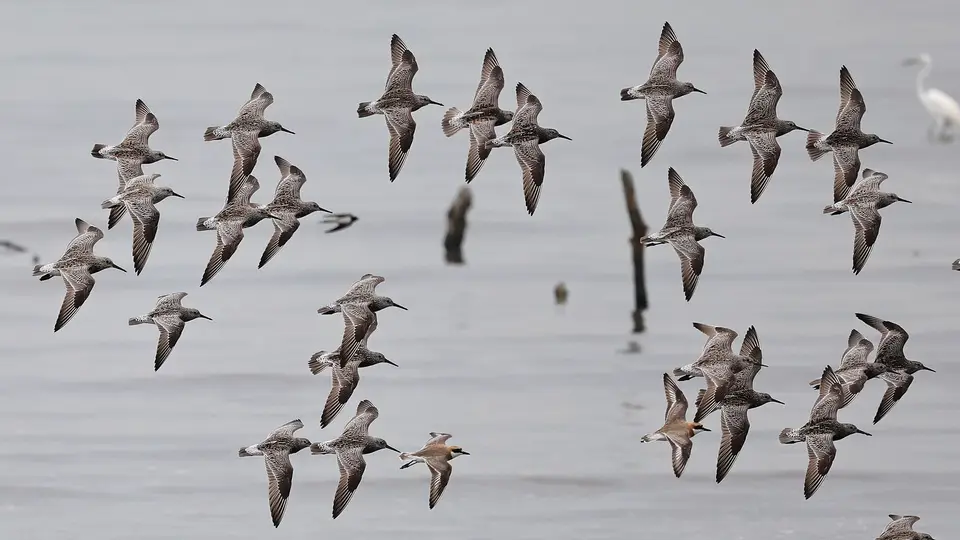
Twice a year, huge numbers of birds pass along China's coast. Shorebirds that nested in the Arctic tundra fly south toward Southeast Asia and Australia, and then return north again in spring. Ducks, cranes, spoonbills and pelicans arrive to spend the winter in Chinese wetlands. These journeys follow a route known as the East Asian–Australasian Flyway.
This article explains what the flyway is, why China's coast matters so much, and what is happening to some of its most threatened birds.
What is a flyway?
A flyway is a broad region that migratory birds use to travel between their breeding grounds and their non-breeding grounds. It is not a single narrow path, but a network of wetlands, coasts and stopover sites that birds depend on along the way.
According to the East Asian–Australasian Flyway Partnership (EAAFP), this flyway stretches from the Russian Far East and Alaska, through East and Southeast Asia, to Australia and New Zealand. It covers 22 countries and is used by tens of millions of migratory waterbirds from more than 250 different populations, including dozens of globally threatened species. EAAFP brings together governments, international organizations and NGOs to protect these birds and the wetlands they use.
The Yellow Sea: a vital stopover
Many shorebirds cannot fly the whole distance between the Arctic and Australasia without stopping. They need places to rest and refuel, where they can feed intensively on worms, shellfish and other small animals in the mud.
The intertidal mudflats of the Yellow Sea and the Bohai Gulf, along the coasts of China and the Korean Peninsula, are among the most important of these stopovers. UNESCO describes the region as a bottleneck for many millions of migratory waterbirds. In 2019, two sites on the coast of Jiangsu Province were inscribed on the World Heritage List as the "Migratory Bird Sanctuaries along the Coast of Yellow Sea-Bohai Gulf of China (Phase I)". In 2024 the World Heritage Committee approved an extension that added further coastal sites, including the Yellow River Delta in Shandong and Chongming Dongtan in Shanghai.
You can read more about these habitats in our article on the Yellow Sea tidal flats and our introduction to wetland ecosystems.
Flyway travelers to know
Spoon-billed sandpiper
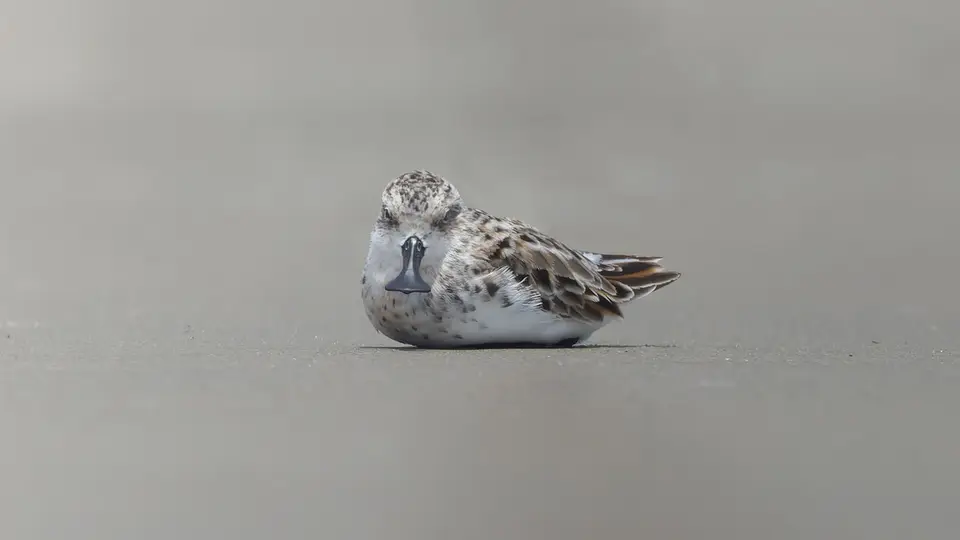
The spoon-billed sandpiper is a sparrow-sized shorebird with a remarkable bill that widens into a flat "spoon" at the tip. It breeds on coastal tundra in the Russian Far East, mainly in Chukotka, and spends the non-breeding season in South and Southeast Asia, which is why the photo above was taken in India.
It is assessed as Critically Endangered. A study published in Oryx in 2016 estimated the world breeding population in 2014 at only about 210 to 228 pairs. The coast of Jiangsu Province is a crucial stopover, where many of the world's spoon-billed sandpipers rest and replace their feathers on the way south. The loss of tidal flats around the Yellow Sea, and hunting and trapping on the wintering grounds, are considered major causes of its decline.
Black-faced spoonbill
The black-faced spoonbill is a white wading bird with a black face and a long, flat, spoon-shaped bill, which it sweeps from side to side through shallow water to catch fish and shrimp. It lives only in eastern Asia and is assessed as Endangered.
Its numbers have risen over recent decades, alongside habitat protection and regular monitoring. The International Black-faced Spoonbill Census, coordinated each year by the Hong Kong Bird Watching Society, counted 7,746 birds in January 2026, a record high. Taiwan held the largest share, with 4,719 birds, while 1,834 were counted on the Chinese mainland and 341 in the Deep Bay area of Hong Kong and Shenzhen.
Dalmatian pelican
The Dalmatian pelican is one of the largest flying birds, with a huge pouched bill and curly feathers on the back of its head. Globally it is listed as Near Threatened, but the East Asian population is tiny. EAAFP estimates that fewer than 150 birds remain in this population. They breed in a small part of western Mongolia and spend the winter along the eastern coast of China. In China the species is under first-class state protection.
Coastal Zhejiang is especially important. According to EAAFP's Dalmatian Pelican Task Force, Wenzhou Bay holds around 50 to 60 wintering birds each year, with a peak of 67 recorded in the winter of 2019/20. Smaller numbers are recorded elsewhere in the province; for example, more than 20 were counted at the Hangzhou Bay Wetland in Ningbo in January 2023. Threats include shooting on the breeding grounds and land reclamation, pollution and disturbance along the Chinese coast.
Other winter visitors
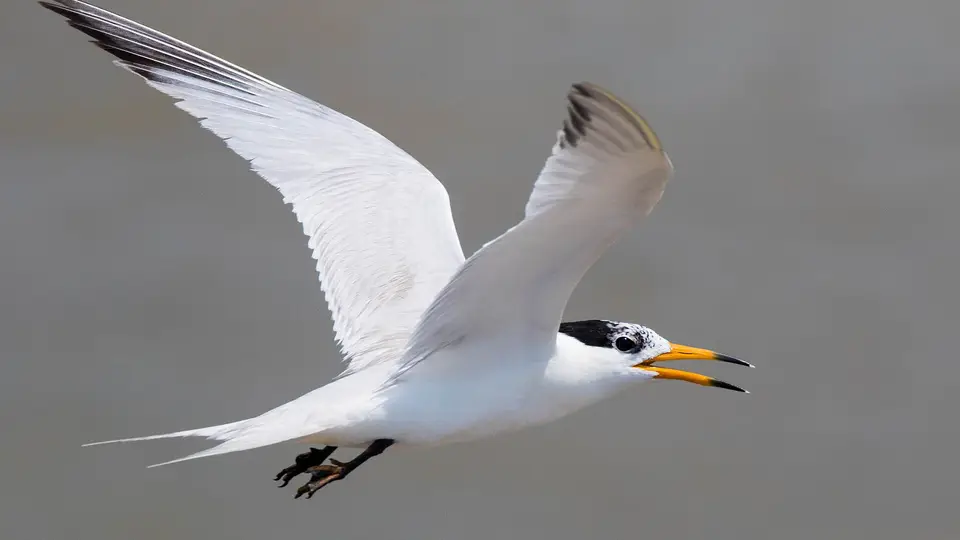
The estuaries, mudflats, fishponds and reedbeds of the Zhejiang coast also host wintering ducks, herons, egrets, gulls and many shorebirds. In summer, the islands off the province are home to one of the rarest seabirds in the world, the Chinese crested tern.
Threats along the flyway
Migratory birds face risks at every stage of their journey. Because they depend on a chain of sites, damage to a single important stopover can affect birds across the whole flyway.
- Loss of tidal flats. Land reclamation for ports, farming, aquaculture and industry has removed large areas of coastal mudflat around the Yellow Sea.
- Illegal hunting and mist nets. Fine, almost invisible nets are used to catch birds for food and for the illegal trade. Chinese prosecutors have used public interest litigation to tackle mist-net hunting, and the revised Wildlife Protection Law bans certain hunting tools.
- Accidental entanglement. In Zhejiang and Shandong, prosecutors have also responded to migratory birds dying in nets that farmers use to protect crops.
- Disturbance and pollution. Boats, vehicles, dogs and people can repeatedly flush resting birds, wasting energy they need for migration. Pollution and invasive plants can degrade feeding areas.
How you can help
- Watch birds responsibly. Keep your distance, especially at high-tide roosts where birds gather tightly together. Follow our guide to ethical wildlife observation.
- Join a count. Bird surveys and citizen-science projects need volunteers. Families and schools can take part with adult supervision and attention to tides and water safety.
- Report illegal nets or hunting to local forestry authorities or the police, without removing nets or confronting anyone yourself.
- Never buy wild birds or eat wild-caught birds.
- Support wetland protection by learning about local coastal sites and speaking up for them.
Birds that pass through China's coast may have been in Russia a few weeks earlier and may be in Australia a few weeks later. Protecting them depends on cooperation across the whole flyway, and on people in every country who notice and care.
References
- East Asian–Australasian Flyway Partnership, "The Flyway". https://eaaflyway.org/the-flyway/
- East Asian–Australasian Flyway Partnership, "Dalmatian Pelican Task Force". https://eaaflyway.org/dalmatian-pelican-task-force/
- UNESCO World Heritage Centre, "Migratory Bird Sanctuaries along the Coast of Yellow Sea-Bohai Gulf of China". https://whc.unesco.org/en/list/1606
- BirdLife International, "New World Heritage sites in China help migratory birds", 2024. https://birdlife.org/news/2024/07/30/new-world-heritage-sites-in-china-help-migratory-birds
- Clark NA, Anderson GQA, Li J, et al., "First formal estimate of the world population of the Critically Endangered spoon-billed sandpiper Calidris pygmaea", Oryx, 2016. https://doi.org/10.1017/S0030605316000806
- Hong Kong Bird Watching Society, "International Black-faced Spoonbill Census 2026". https://cms.hkbws.org.hk/cms/en/hkbws/work/endangered-species/bfs-en/bfs-census-en-2026
- China Daily, "Rare birds spotted at Hangzhou Bay Wetland", 2023. https://ningbo.chinadaily.com.cn/2023-01/11/c_847287.htm
- China Daily / Beijing Review, "How Chinese procuratorial authorities help with migratory birds protection", 2025. https://subsites.chinadaily.com.cn/spp/2025-02/10/c_1069481.htm