Nature-based learning: approaches, evidence and how teachers can start
Taking lessons outdoors can support attention, wellbeing and engagement. This guide explains the main approaches, summarizes the evidence honestly, and offers practical first steps for teachers.
"Nature-based learning" is a broad term for teaching and learning that takes place in, or makes deliberate use of, natural settings. It can mean a weekly math lesson in the school garden, a kindergarten that spends most of its day in a woodland, or a secondary-school biology project on a local pond. What these approaches share is the idea that the outdoors is not only a topic to learn about, but also a place to learn in.
This guide outlines the main approaches, summarizes what research suggests, and gives practical advice for teachers who want to begin.
Main approaches
Forest School and nature kindergartens
Forest School is a long-term, child-centered approach in which groups visit the same woodland or natural area regularly, often over many months. Learners take part in play, exploration and supported risk-taking, such as climbing, using simple tools or building shelters, under trained leaders. In the United Kingdom, the Forest School Association acts as a professional body and sets out principles describing what Forest School should involve.
Nature kindergartens (sometimes called forest kindergartens) are early-years settings where children spend much or most of the day outdoors in all seasons. They are found in many countries, particularly in northern Europe.
Curriculum-based outdoor teaching
In some schools, ordinary subject lessons are regularly moved outdoors, for example one day a week. In Scandinavia this is often called udeskole. The point is not a special "nature lesson" but teaching the normal curriculum—reading, mathematics, science, language—in an outdoor setting, often in the schoolyard or a nearby park.
Place-based education
Place-based education uses the local community and environment as a starting point for learning. Students might study the history of a nearby river, interview farmers about changes in the seasons, or map trees on their street. It often connects environmental topics with local culture and civic life.
Nature play
Unstructured play in natural spaces—digging, building, climbing, hiding—is valuable in its own right, especially for younger children. Many schools add natural elements such as logs, boulders, planting beds and digging areas to their playgrounds.
Field-based investigation
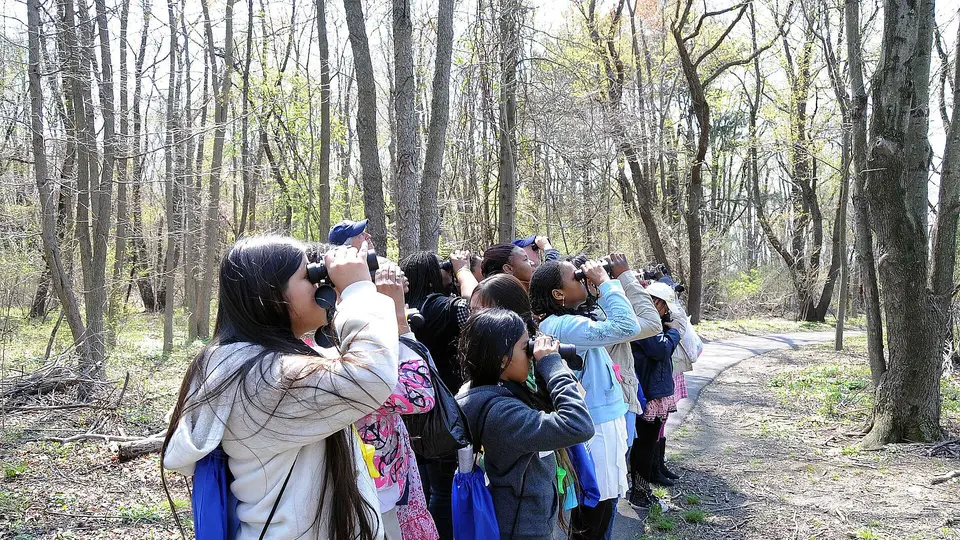
Older students can carry out real investigations outdoors: surveys of plants and insects, water-quality testing, bird counts or weather monitoring. These connect naturally to citizen-science projects. Our guides to school conservation activities and student river watch give step-by-step examples.
What the evidence says
Interest in outdoor learning has grown faster than the research base, so it is worth being precise about what studies show.
- A 2017 systematic review by Christoph Becker and colleagues examined regular, compulsory, curriculum-based outdoor education programs for students aged 5 to 18. Only 13 studies met their inclusion criteria. Eleven reported positive effects, one reported both positive and negative effects, and one reported negative effects, across learning, social and health outcomes. The authors described their conclusions as tendencies and called for more research, noting that physical activity and mental health were under-studied.
- A 2019 review by Ming Kuo, Michael Barnes and Catherine Jordan brought together evidence on nature and learning. The authors concluded that nature experiences appear to promote children's academic learning and personal development. They identified several plausible pathways, including improved attention, lower stress, better self-discipline, greater interest and enjoyment, more physical activity, and calmer, quieter learning settings. They suggested nature-based instruction deserves particular attention for students who are not well served by traditional classrooms.
- A 2020 systematic review by Nicole Ardoin and A. W. Bowers of 66 studies in early childhood environmental education found mostly positive results for environmental literacy and for cognitive, social and emotional development.
These reviews are encouraging, but they also show the limits of the evidence. Many studies are small, use different measures and do not randomly assign students to groups. Families who choose outdoor-focused schools may differ from those who do not. Nature-based learning is best seen as a promising approach that needs careful planning, not as a guaranteed fix.
How teachers can start
You do not need a forest, a large budget or special training to begin, though training is valuable if you plan to use tools, fires or remote sites.
1. Start close and small
The schoolyard, a nearby park or even a row of street trees is enough. Short, regular sessions—15 to 30 minutes once a week—help students and staff build routines and confidence. A single grand trip once a year is less effective at building those habits.
2. Plan with a learning objective
Decide what students should learn or practise, and why being outdoors helps. Examples:
- Measuring and estimating: tree heights, shadow lengths, area of a planting bed.
- Science: comparing insect numbers in sun and shade, recording leaf changes through the seasons.
- Language: descriptive writing or poetry based on direct observation.
- Art: drawing from life, natural pigments, land art that is taken apart afterwards.
3. Set clear routines and boundaries
Agree on a meeting point, a signal to gather (such as a whistle or call), and the boundaries of the area. Explain rules about handling plants and animals: look closely, but do not pick, collect or disturb without a good reason and permission. The principles in our guide to ethical wildlife observation apply to classes as much as to adults.
4. Think about risk and benefit together
Outdoor learning involves some risk, and that is part of its value: children learn to judge hazards. A sensible approach weighs benefits against risks rather than trying to remove every risk. Check the site beforehand for hazards such as broken glass, steep drops, traffic, water, stinging plants or animals. Follow your school's and education authority's policies on supervision, first aid and consent. For off-site visits, see our guide to planning safe field trips and nature camps.
5. Prepare for weather and comfort
Ask families to send suitable clothing and shoes. Keep spare layers if possible. Plan for heat and sun as well as rain and cold: shade, water and hats matter. Have an indoor alternative for dangerous weather such as thunderstorms or extreme heat.
6. Make it inclusive
Check that routes and activities are accessible for students with disabilities. Some children have little experience of nature and may be anxious about insects, dirt or open spaces; start gently. Be aware of allergies, including to insect stings and plants.
7. Bring learning back inside
Follow-up is where much of the learning is consolidated. Students can analyze data, write reports, compare findings with published information or share results with other classes and families.
8. Involve families and colleagues
Explain to parents why lessons sometimes happen outdoors and what students will gain. Share photos and student work. Working with colleagues in other subjects makes outdoor learning easier to sustain.
A note on wildlife and safety
Students should never handle wild animals, especially birds, bats, reptiles or mammals, both for the animals' welfare and because of disease and bite risks. If students find an animal that appears injured, the right step is to keep a distance and inform an adult, who can contact local wildlife authorities or a licensed rescue center.
Useful organizations
- Forest School Association (UK) – principles and training information for Forest School practice.
- Council for Learning Outside the Classroom (UK) – guidance and resources on learning outside the classroom.
- Children & Nature Network – a research library on children and nature.
For a wider list, see our guide to environmental education for children.
References
- Becker, C., Lauterbach, G., Spengler, S., Dettweiler, U. and Mess, F., "Effects of regular classes in outdoor education settings: A systematic review on students' learning, social and health dimensions", International Journal of Environmental Research and Public Health 14(5):485, 2017. https://pmc.ncbi.nlm.nih.gov/articles/PMC5451936/
- Kuo, M., Barnes, M. and Jordan, C., "Do experiences with nature promote learning? Converging evidence of a cause-and-effect relationship", Frontiers in Psychology 10:305, 2019. https://doi.org/10.3389/fpsyg.2019.00305
- Ardoin, N. M. and Bowers, A. W., "Early childhood environmental education: A systematic review of the research literature", Educational Research Review 31, 2020. https://doi.org/10.1016/j.edurev.2020.100353
- Forest School Association. https://forestschoolassociation.org/
- Council for Learning Outside the Classroom. https://www.lotc.org.uk/
- Children & Nature Network, "Resources". https://www.childrenandnature.org/resources/